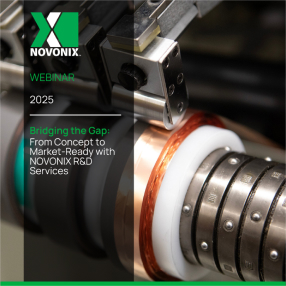
Calendering is a manufacturing process in battery electrode production where coated electrode sheets (with active material, binder, and conductive additives on a metal foil) are passed through rollers to compress them. This rolling compacts the electrode, reducing its thickness and increasing its density to a precise specification. Proper calendering improves the contact between particles and the current collector, potentially enhancing electrical conductivity and energy density of the electrode. However, excessive compression can reduce the porosity required for electrolyte infiltration or cause mechanical stress, while insufficient compression leaves voids that increase resistance. Thus, calendering must be carefully controlled to achieve the optimal balance for performance.
NOVONIX utilizes calendering in its electrode fabrication for both research and pilot-scale cell production. By adjusting the calendering pressure, roll gap, and number of passes, NOVONIX can study how electrode density affects battery performance metrics, such as capacity, power capability, and cycle life. Their findings help in determining the ideal calendering conditions for different material formulations. Additionally, NOVONIX’s insights inform equipment design and process parameters for clients scaling up electrode manufacturing, ensuring that the calendering step is optimized for consistency and high-quality electrodes in mass production.